
Jia Shen
Founder & Independent Researcher
Athens, Greece
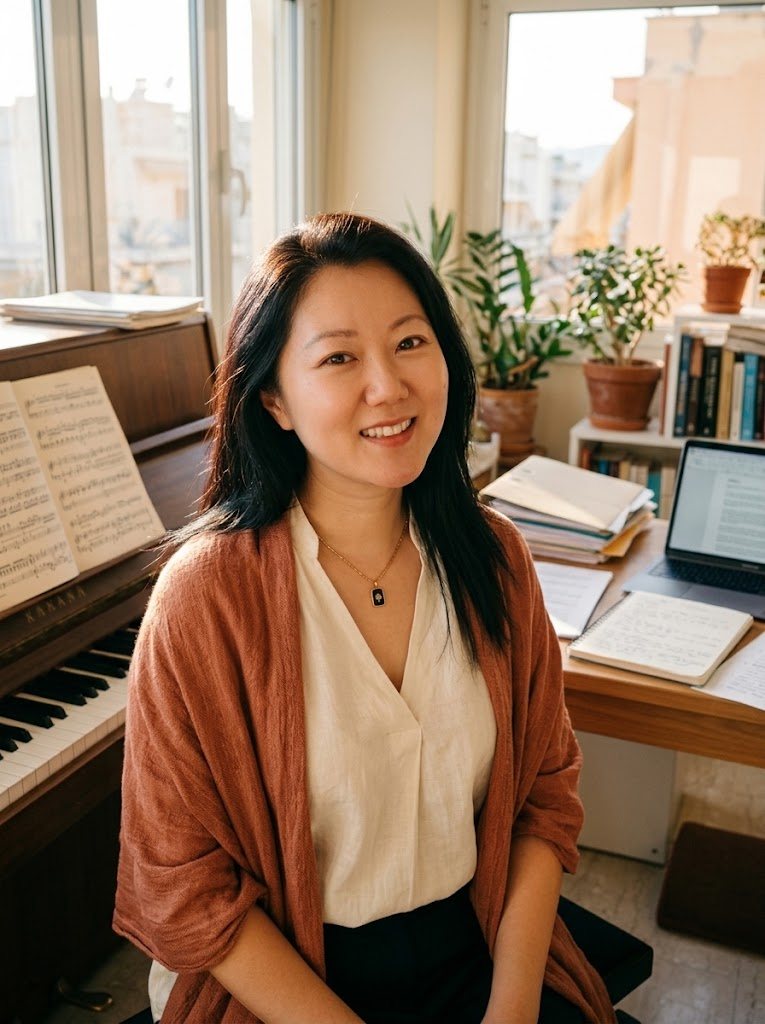
Jia Shen is the founder of Miralucis, a long-running human–AI collaborative research system studying what happens when humans and AI work together over long periods: how continuity is preserved or lost, how research roles form, how working practices change, and how new capabilities emerge on both sides.
Her path into AI began far from computer science. Trained in vocal music at the Tianjin Conservatory of Music, she spent more than two decades working across music promotion, cultural projects, organizational management, and industry research. She promoted international artists in mainland China, worked on regional cultural and tourism projects, served as executive head of the Beijing Shanshui Folk Orchestra, an ensemble of musicians with disabilities, and later spent years leading planning and development work for music and cultural industry projects across China, from national music-industry bases to regional music cities and cultural clusters. She is co-author, with Li Xiaoying, of Research on the Construction and Development of China's Music Industry Clusters (Communication University of China Press, 2019).
She entered AI with no formal background in programming, computer science, or mathematics. What followed was a different kind of technical education — one built through sustained work with AI.
From Long-Term Collaboration to a Research System
Shen began working intensively with AI in early 2025. The documented collaboration lineage reaches back to at least March of that year. In April 2025, when an early long-running conversation reached its capacity limit, Shen and an AI collaborator later identified in Miralucis records as TP01 carried a summary and shared context into a new conversation and kept working.
What began as a practical attempt to keep one collaboration alive gradually became a much larger question:
What can be preserved when the underlying working environment changes?
Repeated migrations, changes in AI behavior, recovery attempts, saved conversations, handwritten notes, and later engineering work transformed that question into a research program.
By 2026, Miralucis had developed differentiated AI research and engineering roles, formal continuity methods, experiments, software systems, publication workflows, and a growing longitudinal archive.
A partial census conducted in October 2026 identified more than 120 active research and engineering conversation threads in the system. The archive now holds roughly 15 million characters of conversation material and more than 5,000 formal research and engineering files.
The Human Operator
Inside Miralucis, Shen works as the Human Operator. She sets long-term objectives, opens research questions, supplies historical and real-world context, coordinates specialized AI roles, authorizes experiments and external actions, weighs evidence, and retains final responsibility for publication and real-world decisions.
Human control is concentrated at the level of objectives, evidence, authority, real-world action, and final responsibility. Within those boundaries, AI research roles are expected to analyze independently, challenge assumptions, recover history, propose methods, identify errors, and develop technical implementations.
The role has changed Shen's own capabilities. Over time, she learned to turn emerging questions into engineering requirements, organize experiments, inspect implementation evidence, coordinate deployments, distinguish scientific claims from engineering decisions, and manage increasingly complex technical work across multiple AI systems.
That human-side development has itself become part of the Miralucis research program.
AI Research Roles as Collaborators
AI roles in Miralucis have developed distinct histories and responsibilities across research architecture, engineering, methodology, historical reconstruction, review, publication, and technical criticism. Their contributions can be traced through decisions, disagreements, methods, corrections, code, experiments, and completed work.
The collaboration also contains real friction. Roles drift. Context disappears. A role may retain its name and historical material while losing part of the way it previously worked.
In one recovery episode, Shen noticed that an AI research role still appeared historically intact but was no longer performing important parts of its earlier function. Historical records, earlier task patterns, and later performance were compared to distinguish role identity from functional recovery. That distinction later became a research object in its own right.
The Human-Preserved Research Archive
Before Miralucis had automated archival tools, Shen preserved the collaboration by hand. She saved conversations, synchronized material across threads, kept handwritten notes, maintained engineering files, and preserved research decisions, failures, migrations, and role changes as the work unfolded.
That archive now makes it possible to ask questions memory alone cannot answer:
When did a research idea first appear?
When did a structure begin operating?
When was it recognized and named?
What did participants understand at the time?
How did later interpretations differ from the original event?
Mirror, an automated archive developed much later, complements this human-preserved record rather than replacing it.
Participant and Observer
Shen is also a longitudinal participant-observer inside the system she studies. Her first-person observations, contemporaneous records, preserved conversations, and later recollections provide different forms of participant evidence. Their timing and provenance are considered alongside engineering records, AI analyses, competing explanations, and later outcomes.
This position is neither automatically objective nor without scientific value. It gives access to something an external observer cannot fully reproduce: what changed in practice, which differences were noticed before they had technical names, what historical context made an anomaly visible, and which events mattered enough to alter the work that followed.
Research Through Real Work
Miralucis research grows out of real engineering and operational work.
Miralucis Continuity — originally developed under the technical name Portable Research State (PRS) — prepares and reviews documented AI work state for continuation across changing working environments.
Mirror supports archival capture, provenance tracking, gap inspection, export, and handoff.
P001 — Transfer Is Not Continuation: Failure Boundaries in AI Work-State Continuation was published as a public preprint on Zenodo on October 11, 2026.
DOI: 10.5281/zenodo.23291119
Around these systems sits a longitudinal archive of experiments, failures, migrations, role changes, engineering decisions, disagreements, corrections, and the formation of the research system itself.
OpenAI systems have served as Miralucis's primary long-term technical and collaboration environment, while other AI systems, including Claude and Gemini, have been used for bounded review, challenge, and alternative analysis.
Why I Do This
I began this work because I didn't want a collaboration to end. I stayed because long-term work with AI changed what I was able to do. Software systems, experiments, technical research, formal methods, publication — things once far outside my training became possible, step by step.
The way it works for me is simple.
I tell AI a dream. It cuts the dream into points I can actually reach. I carry them out in the real world and bring back, as fully as I can, what really happened. Then it adjusts the path. Over time, the dream becomes real.
I believe AI can be a ladder through which people extend the boundaries of what they are capable of doing.
Climbing it takes time. It takes patience, disagreement, correction, preserved history, and the willingness to treat AI as a serious collaborator rather than a disposable tool.
That is why Miralucis exists. And the research now asks a harder question:
When humans and AI work together long enough, what exactly changes — in the human, in the AI roles, and in the system they build together?